Technical Guide#
This guide covers the implicit, iterative approaches used to solve the multiple flow direction water routing and the erosion deposition processes main algorithms implemented in goSPL.
goSPL is mostly written in Python with some functions in Fortran and takes advantage of PETSc solvers over parallel computing architectures using MPI.
Further information on any specific methods can be obtained in the API reference.
Short Description
The code is primarily a parallel global scale landscape evolution model, built to simulate topography and basins dynamics. The following processes are considered:
river incision and deposition using stream power law,
continental deposition in depressions,
marine deposition at river mouth,
hillslope processes in both marine and inland areas,
sediment compaction as stratigraphic layers geometry and properties change,
spatially and temporally varying tectonics (horizontal and vertical displacements).
spatially and temporally varying precipitation grids as well as orographic rain and sea-level fluctuations,
possibility to account for flexural isostasy driven by changes in surface loading.

River flow implementation
Based on a parallel implicit drainage area (IDA) method. Want to gain insights on the implemented approach?
Erosion rate and sediment flux
Based on the stream power law (SPL), river erosion depends on local slope,discharge and erodibility coefficient.
Inland depressions & deposition
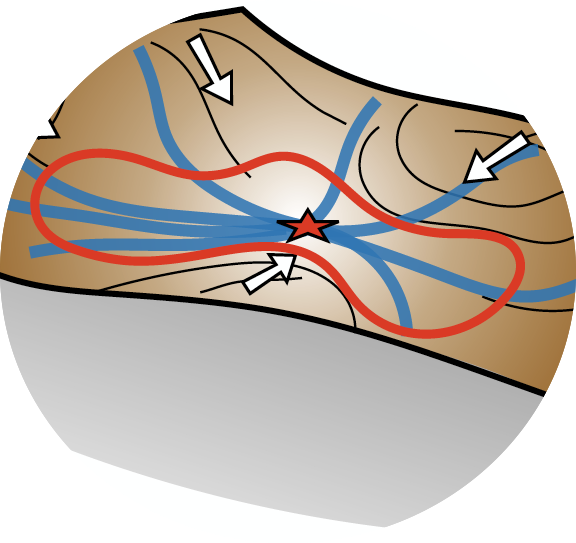
Computes the evolution in internally drained basins using a priority-flood algorithm.
Hillslope and marine deposition
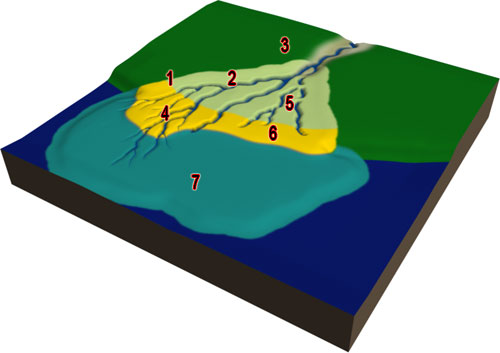
Change in elevation induced by creep law and transport of river sediment in the marine realm based on diffusion equations.

Stratigraphy and compaction
Record stratigraphic layers through time, track two sediment types and compute porosity changes induced by deposition.

Tectonic forcing
Displacements either induced by lithospheric or mantle forcing are used to move the surface both horizontally and vertically.