
Stratigraphy and compaction#
Stratigraphic record#
Note
Stratigraphic architecture records surface evolution history from sediment production in the continental domain to its transport and deposition to the marine realm. To interpret stratigraphic architecture, goSPL integrates the complete source-to-sink system: river erosion, sediment transport and deposition.
When the stratigraphic record option is turned on in goSPL, stratigraphic layers are defined locally on each partition and for each nodes and consist in the following information:
elevation at time of deposition,
thickness of each stratigraphic layer, and
porosity of sediment in each stratigraphic layer computed at centre of each layer.
When stratigrapht is activated in goSPL, the erosion, transport and deposition are recorded at any given time steps. This requires to keep track of all layers previously deposited. In this case, several assumptions are made. First, the model assumes that the volume of rock eroded using the stream power law accounts for both the solid and void phase. Second, the volume of eroded material corresponds to the solid phase only and has the same composition as the eroded stratigraphic layers.
Inland deposits thicknesses and composition are then updated and recorded in the top stratigraphic layer and the porosities are set to the uncompacted sediment value.
Porosity and compaction#
To properly simulate stratigraphic evolution, sediment compaction is also considered in goSPL as it modifies the geometry and the properties of the deposits.
Sediments compaction is assumed to be dependent of deposition rate and porosity \(\mathrm{\phi}\) is considered to varies with depth \(\mathrm{z}\) following the formulation proposed by Sclater and Christie, 1980 based on many sedimentary basins observations:
where \(\mathrm{\phi_0}\) is the surface porosity of sediments, and \(\mathrm{z_0}\) is the e-folding sediment thickness for porosity reduction.
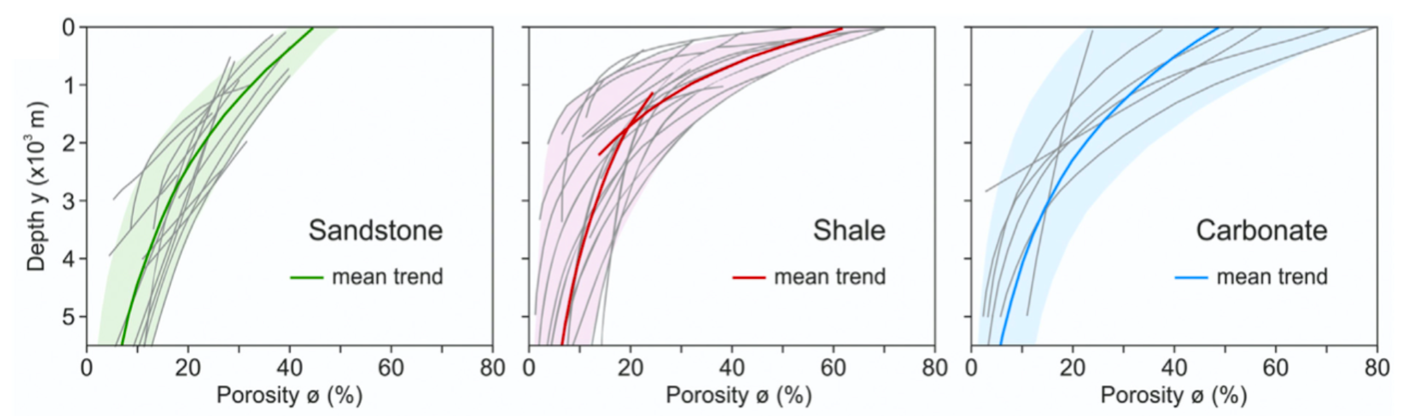
Fig. 5 Compilation plots of published compaction trends (grey lines) of sandstone, shale, carbonate (from Lee et al., 2020). The mean trend of each plot is defined by exponential function. A set of two exponential curves is applied to shale to fit better the underlying range.#
As shown in the figure above, porosity decreases for burial depth of the order of a few thousand meters (\(\mathrm{z_0}\)), accordingly associated compaction increases substantially (Sclater and Christie, 1980). We can also see that the porosity and rate of compaction between fine and coarse sediments are significantly different. As a result, goSPL uses the proportion of coarse versus fine at all depths within the underlying stratigraphy column to properly estimate compaction and induced elevation changes.
For a given stratigraphic layer \(\mathrm{i}\), the associated porosity is obtained at the centre of the layer for a specific depth \(\mathrm{\bar{z}_i}\) by:
At a given time \(\mathrm{k}\) after \(\mathrm{i}\), the layer centre depth is defined by:
where the thickness of that layer \(\mathrm{\Delta z_i^{k}}\) is related to the amount of solid material deposited in the layer \(\mathrm{\Delta h_{S,i}}\) by the following relationship:
The values of \(\mathrm{\Delta z_i^{k}}\) for \(\mathrm{i=1,...,k}\) are then computed sequentially from the top to the bottom of the sedimentary pile.
Sedimentary layer elevation is then decreased based on the sum of compaction happening in each layer between two consecutive time steps.
Bedrock sentinel#
When no initial stratigraphy file (npstrata) is provided, goSPL treats stratigraphic layer 0 as an effectively infinite bedrock reservoir by initialising its thickness to a sentinel value of \(\mathrm{10^6}\) m. The erosion logic adds and subtracts this offset internally so it cancels out of all eroded-volume calculations.
The compaction step explicitly freezes the sentinel layer: when bedrockLay > 0 the corresponding rows of \(\mathrm{\Delta z}\) and \(\mathrm{\phi}\) are restored to their pre-compaction values at the end of _depthPorosity. Without this, the sentinel would compute a near-zero equilibrium porosity at the resulting half-million-metre burial depth and shrink to roughly half its thickness in a single step, producing a catastrophic surface drop.
When an npstrata file is provided, by default no sentinel is added (bedrockLay = 0) and the deepest file layer is itself the un-erodable floor — the erosion offset is applied to layer 0 regardless, so erosion can never cut below it, but that layer then defines the infinite-reservoir composition. Set strata: bedrock_sentinel: True to instead insert a dedicated infinite-bedrock layer beneath the file layers: the file’s layers shift up by one and become finite (erosion can exhume through them), layer 0 becomes the frozen \(\mathrm{10^6}\) m reservoir with the bedrock_coarse_frac composition, and bedrockLay is set to 1 so the same compaction freeze applies.
Porosity inheritance for empty layers#
Stratigraphic layers can become empty between erosion and the next deposition window — their thickness is set to zero and their porosity is cleared. To keep the output porosity field continuous (and to avoid spurious zero values in compaction calculations on subsequent steps), zero-thickness layers inherit the porosity of the nearest underlying layer with non-zero porosity. The fill is a vectorised forward-fill along the layer axis:
with the convention that leading zeros at the column base (no valid layer below) remain zero. This is applied both at the end of _depthPorosity (after compaction) and at the end of erodeStrat (after erosion).
Per-layer erodibility multiplier#
For runs initialised from an npstrata file, goSPL accepts an optional stratK field of shape (mesh_points, initial_layers) containing a per-layer multiplier applied to the SPL erodibility coefficient. The effective per-node erodibility seen by the stream-power law becomes
where \(\mathrm{K}\) is the scalar value declared in the YAML spl block, \(\mathrm{s_K(i)}\) is the multiplier read from the topmost non-empty layer in node \(i\)’s stratigraphic column, \(\mathrm{f_{sed}(i)}\) is the optional sedfactor map, and \(\mathrm{P_i^{\,d}}\) is the precipitation-dependent term controlled by the YAML spl.d exponent.
The multiplier is stored as self.stratK[lpoints, stratNb] parallel to stratH / phiS, with these conventions:
Initial layers: read directly from the
stratKkey of thenpstratafile. If the key is absent, all initial layers default to1.0(no scaling).Bedrock sentinel (no
npstratafile): layer 0 defaults to1.0so the SPL falls back to the YAML-default \(\mathrm{K}\).Freshly deposited layers:
stratKis reset to1.0. Material eroded from a bedrock layer and re-deposited downstream therefore loses the bedrock-specific multiplier — physically, the rock has been broken into sediment and no longer carries its original resistance.Emptied layers:
stratKis cleared to zero alongsidestratH/phiSand then forward-filled from the nearest non-empty layer below, so a partially-exhumed column always exposes a real bedrock multiplier at the surface.
The lookup of the surface multiplier is a vectorised search for the highest non-zero layer index per node, performed once per SPL evaluation. When stratigraphy is disabled (stratNb == 0) or the column is fully empty, the helper returns 1.0 and the SPL behaviour is identical to a run without stratK.
Note
The per-layer multiplier is a single value per layer and applies only to the bedrock SPL coefficient. It does not scale the soil-layer erodibility Ksoil in the soil-coupled SPL flavour. In the dual coarse/fine configuration it composes multiplicatively with the lithology-blended erodibility K * surfK * (fc + ff * fine_k_factor) (see Dual lithology below).
Dual lithology (coarse / fine)#
When stratigraphy is enabled, goSPL can optionally track two sediment lithologies — coarse (sand) and fine (silt/clay) — separately through erosion, transport, deposition, compaction and advection. It is an opt-in feature: with it off (the default) the model is identical to the single-fraction behaviour described above.
Enable it with a strata block in the input file:
strata:
    dual: True
    coarse: {phi0: 0.49, z0: 3700.}              # coarse porosity-depth curve
    fine:   {phi0: 0.63, z0: 1960., k_factor: 1.5}  # fine curve + erodibility ratio
    bedrock_coarse_frac: 0.6                      # coarse fraction of bedrock
    bedrock_sentinel: True                        # infinite bedrock below the npstrata layers
    fine_diff_factor: 2.0                         # fine diffuses 2x faster
    pitInletBias: {coarse: 0.5, fine: 0.0}        # lake delta vs depocenter
The initial per-vertex coarse/fine distribution is supplied through the
npstrata file (the strataHf/phiF layer arrays — see
the input-file guide). On load goSPL validates that the
required fields are present and that every layer array shares the
(mesh_points, n_layers) shape of strataH, raising a clear error
otherwise; under dual lithology a missing strataHf triggers a rank-0
warning (the initial pile is then all-coarse). Running with -v prints a
one-line summary of the stratigraphy setup.
Each stratigraphic layer stores a total thickness and a fine-fraction thickness, plus a porosity for each lithology. The two fractions are governed by independent physical parameters:
Porosity / compaction: each lithology compacts on its own depth-porosity curve (
coarse/finephi0,z0). Because fines are more porous and compact more, the same solid load yields a different preserved thickness depending on the grain mix.Erodibility: the surface SPL coefficient is blended by the exposed composition,
K_eff = K · (f_c + f_f · fine_k_factor), so fine-rich surfaces can be more (or less) erodible than coarse.Diffusivity: the hillslope/soil diffusion coefficient is blended the same way,
Cd_eff = Cd · (f_c + f_f · fine_diff_factor)(a multiplier on the existinghillslopeKa/hillslopeKm/nonlinKmcoefficients — it does not replace them), so fines diffuse faster.
“Fines travel farther” is realised at the deposition stage: within lakes and depressions the fine fraction is biased toward the depocenter while coarse builds the inlet/margins, and in the marine domain fine concentrates in deeper/distal water while coarse stays proximal. The per-fraction deposited volume is conserved by this re-partition; the deposit geometry (and therefore the elevation evolution) is unchanged relative to the total-sediment result.
In lakes/depressions the strength of this segregation is the pitInletBias
contrast coarse − fine: the per-node fine fraction varies about each
pit’s mean by the depth shape factor \(1 + (\mathrm{coarse}-\mathrm{fine})\,(d/\bar{d} - 1)\),
with bathymetric depth \(d\) and deposit-weighted mean depth \(\bar{d}\).
Equal biases give a uniform composition (no segregation), coarse > fine
(e.g. {coarse: 0.5, fine: 0.0}) concentrates fine in the deep depocenter,
and coarse − fine == 1 is the maximum, fully depth-proportional split. The
shape factor has deposit-weighted mean zero, so the pit’s retained fine volume
is conserved at any strength.
Fine-enriched overspill is also modelled: in a filled depression coarse settles first (is retained up to the pit capacity), so the deposit kept in the pit is coarse-enriched while the excess that overspills is fine-enriched and continues downstream — ultimately reaching the distal marine basin. The fine sub-volume is threaded through the depression-filling cascade in lockstep with the total, conserving fine mass to within the floor/transit budget.
Glacial till couples to the stratigraphic record when the ice sheet model is run with till handling on: the rock abraded under sliding ice is removed from the stratigraphic layers it came from and re-deposited as a fresh moraine layer in the ablation zone. Under dual lithology the moraine carries the abraded (ice-mixed) fine fraction, so coarse and fine are tracked through the glacial pathway exactly as through the fluvial one, and the per-fraction solid budget stays balanced.